9 Best Juicers Under $100 (November 2026)
The best juicers under 100 dollars include the BLACK+DECKER 32oz Electric Citrus Juicer for measured citrus batches, the Juilist Juicer Machines for fast whole-produce prep, and the TUUMIIST Juicer Machines for slow whole-fruit pressing.
On this page (8 sections)
- Which juicer under 100 dollars fits your routine?
- The best juicers under 100 dollars by use
- How do you choose between citrus, centrifugal and cold press?
- Does a wider feed chute save time?
- How much juice do you need to make at once?
- What cleaning features matter for a budget juicer?
- Are juicers under 100 dollars suitable for daily use?
- Verdict: which juicer under 100 dollars should you choose?
The best juicer under 100 dollars for most whole-produce needs is the Juilist Juicer Machines, with a 3-inch chute and three speed settings. For citrus-only use, choose a dedicated press; for slow extraction, consider the TUUMIIST cold-press model.
This group covers three different jobs: squeezing citrus, separating juice from whole produce at speed, and pressing produce slowly. Decide which style you need first, then compare chute size, batch capacity and cleanup.
Our picks at a glance
-
1
 Best for measured citrus batches
BLACK+DECKER 32oz Electric Citrus Juicer
9.7/10 our score
See it on Amazon -
2

-
3

- 4
 Check it
HOUSNAT Juicer Machines for Whole Fruit
Best for adjustable everyday juicing - 5
 Best for foam separationCheck it
- 6
 Check it
Magic Bullet Mini Juicer with Cup
Best for personal servings - 7
 Check it
Elite Gourmet 24 oz Electric Citrus Juicer
Best for compact citrus servings - 8
 Check it
QCen Juicer Machine 500W Centrifugal Juicer
Best for two-speed produce control - 9
 Check it
SIFENE Centrifugal Juicer Machine
Best for a separate pulp bin
Which juicer under 100 dollars fits your routine?
The best fit depends on what you plan to juice most often. Citrus presses handle oranges and lemons, centrifugal machines suit quick fruit and vegetable batches, and cold-press models use a slower pressing motion.
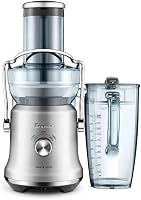
For a specific brand example, see whether the Breville juicer is masticating.
We compared the listed features and intended uses against those needs. Our score weighs specs, features and buyer feedback against what you’re shopping for.
A higher score reflects a closer match to common under-100 dollars needs, based on listed information.
| Product | Best for | Juice style | Container | Cleanup | Our score |
|---|---|---|---|---|---|
| BLACK+DECKER 32oz Electric Citrus Juicer | measured citrus batches | Citrus | 32 oz | Dishwasher safe | 9.7 |
| Juilist Juicer Machines | fast whole-produce prep | Centrifugal | 9.6 | ||
| TUUMIIST Juicer Machines | slow whole-fruit pressing | Cold press | 9.5 | ||
| HOUSNAT Juicer Machines for Whole Fruit | adjustable everyday juicing | Centrifugal | 9.4 | ||
| GDOR 800W Juicer Machine | foam separation | Centrifugal | 9.2 | ||
| Magic Bullet Mini Juicer with Cup | personal servings | Centrifugal | 9.1 | ||
| Elite Gourmet 24 oz Electric Citrus Juicer | compact citrus servings | Citrus | 24 oz | 9.1 | |
| QCen Juicer Machine 500W Centrifugal Juicer | two-speed produce control | Centrifugal | 8.5 | ||
| SIFENE Centrifugal Juicer Machine | a separate pulp bin | Centrifugal | 8.0 |
The best juicers under 100 dollars by use
The BLACK+DECKER is the strongest fit for measured citrus batches, while Juilist leads for quick whole-produce prep. The remaining picks address slow pressing, adjustable speeds, personal cups and separated pulp storage.
BLACK+DECKER 32oz Electric Citrus Juicer: Best for measured citrus batches
- 32 oz clear container
- Adjustable pulp control
- Auto-reversing cones
- Dishwasher-safe parts
A clear, marked pitcher and adjustable pulp control suit recipes that call for measured citrus juice. It is designed for citrus rather than whole fruits and vegetables.
Pros
- Marked clear container
- Adjustable pulp control
- Auto-reversing cones
Cons
- Citrus only
- Larger pitcher takes more storage space than a personal cup
The BLACK+DECKER is built for citrus, with an auto-reversing reamer and a clear 32 oz container with measurement marks. The adjustable pulp control lets you choose how much pulp passes into the juice, while the removable basket collects pulp for disposal or use in recipes.
The container doubles as a pitcher, with a handle and drip-free pour spout. Dishwasher-safe parts can make cleanup simpler after squeezing oranges or lemons for a recipe.
This is a useful choice when you want to measure a citrus batch as you work. It won’t replace a centrifugal machine for carrots, celery or whole apples.
Choose it for citrus recipes and larger measured batches. If you want a dedicated press with a smaller footprint, compare the best Hamilton Beach juicer options before deciding.
Juilist Juicer Machines: Best for fast whole-produce prep
- 3-inch feed chute
- 3 speed settings
- Compact countertop design
- Dishwasher-safe accessories
The wide chute and three settings fit buyers who want to juice a mix of soft and hard produce. A brush is included for cleaning the filter.
Pros
- Wide feed chute
- Three settings for different produce
- Compact design
Cons
- Not intended for hard fruits with a hard core
- High-fiber, low-juice vegetables should be juiced in small amounts
Juilist balances a 3-inch feed chute with three speed settings, making it the most flexible fast-prep pick here. Its low setting is intended for soft produce such as oranges and watermelon, while the higher setting is for harder items such as apples and carrots.
A pulse setting adds a short boost, and the compact body takes up less counter space than a larger machine. A cleaning brush is included for the filter, and the maker says the accessories are dishwasher safe.
The stated guidance cautions against hard fruits with a hard core and recommends juicing high-fiber, low-juice vegetables in small amounts. Keep those limits in mind if your routine centers on celery or dense produce.
Choose Juilist for a mix of soft and hard produce with less chopping. For a broader comparison of this machine style, see our guide to best centrifugal juicer machines.
For a model-specific look, read the Breville Juice Fountain Cold review.
TUUMIIST Juicer Machines: Best for slow whole-fruit pressing
- Cold-press extraction
- 5.8-inch feed chute
- 55 RPM
- BPA-free materials
This cold-press model pairs slow extraction with a large chute for whole fruits and vegetables. Its maker advises a 20-minute cool-down after each 20 minutes of juicing celery.
Pros
- Large feed chute
- Slow-speed extraction
- Includes cleaning brush
Cons
- Tall 17-inch body needs storage clearance
- Celery use calls for rest breaks
TUUMIIST is the slow-press option in this group. Its 55 RPM extraction and 5.8-inch feed chute are aimed at whole fruits and vegetables, so it can reduce cutting while using a slower process than a centrifugal juicer.
The 17-inch body is taller than the compact personal models, so measure cabinet clearance before setting aside counter or storage space. Assembly matters: the hopper needs to turn until its guide mark lines up with the chamber’s lock symbol.
For celery, TUUMIIST advises pausing the machine for 20 minutes after every 20 minutes of operation. That rest period is useful to plan if celery makes up a large part of your batches.
Choose it for slow extraction and a large chute, provided you have room for its height and can work within its rest guidance.
HOUSNAT Juicer Machines for Whole Fruit: Best for adjustable everyday juicing
- 65 mm feed chute
- 3 speeds including pulse
- 1.6 L pulp collector
- Top-rack dishwasher-safe parts
Three settings and a pulse option let you match the speed to softer or harder produce. The 1.6 L pulp collector reduces the need to empty it between small batches.
Pros
- Three speed options
- Large pulp collector
- Includes cleaning brush and recipe book
Cons
- Designed for light to moderate use
- Needs a cool-down if the motor overheats
HOUSNAT gives you three speeds and a pulse setting for switching between softer and harder ingredients. Its 65 mm chute can fit some larger produce with less prep, and a 1.6 L pulp collector leaves more room for a batch before emptying.
The included recipe book and cleaning brush are useful additions for a first juicer. Detachable parts are described as top-rack dishwasher safe, which can help keep the fine mesh filter clear after use.
The maker describes the machine as suited to light or moderate use, such as 4 to 5 sessions per week. If the motor overheats, unplug it and let it cool for about 15 minutes before restarting.
Choose it if you want three settings, pulse and a larger pulp bin. Its guidance makes it a better fit for moderate home routines than extended, continuous juicing.
GDOR 800W Juicer Machine: Best for foam separation
- 3-inch feed chute
- Two speeds
- 17 oz juice jug
- Foam separator
A built-in foam separator in the juice jug helps separate foam as you pour. The two speeds are intended for softer and harder produce.
Pros
- Wide feed chute
- Jug includes foam separator
- Safety lock and overload protection
Cons
- Two speeds rather than three
- Jug capacity is smaller than a multi-serving pitcher
GDOR stands out for the foam separator built into its 17 oz juice jug. High-speed juicing can create foam with some produce, and the separator helps keep more of it out of your glass as you pour.
Its 3-inch chute reduces the need to cut many fruits and vegetables first. Two speeds offer a low setting for softer foods such as oranges and tomatoes and a high setting for firmer produce such as apples, carrots and celery.
A safety locking arm, overload protection and overheat protection add operating safeguards. The jug’s capacity is smaller than the BLACK+DECKER citrus container, so consider how much you usually make in one batch.
Choose GDOR if reducing foam in a personal-size pour matters more than having three speed choices.
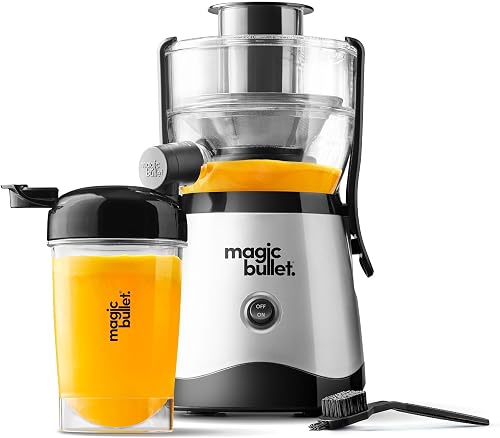
Magic Bullet Mini Juicer with Cup: Best for personal servings
- 16 oz cup with to-go lid
- 2-inch feed chute
- Compact body
- Top-rack dishwasher-safe attachments
Juice goes directly into the included 16 oz cup, which has a twist-on lid for taking it along. Its compact size suits a small counter or cupboard.
Pros
- Juice into the included cup
- To-go lid included
- Small footprint
Cons
- Smaller chute means more prep than a 3-inch model
- Single-serve cup suits smaller batches
The Magic Bullet Mini is designed around an included 16 oz cup with a twist-on to-go lid. Juice goes directly into the cup, which can cut down on extra dishes if you usually make one serving at a time.
Its 2-inch chute is narrower than the 3-inch options, so expect more cutting for larger produce. The compact body can be easier to tuck away, and the attachments are top-rack dishwasher safe.
The cup and small footprint make this a good fit for a single glass, but less convenient for a large breakfast batch. Review the manual before use, as the maker directs.
Choose it for personal servings and compact storage, especially when you want to juice and carry the same cup.
Elite Gourmet 24 oz Electric Citrus Juicer: Best for compact citrus servings
- 24 oz container
- Auto-reversing reamer
- Pulp and seed filter
- Top-rack dishwasher-safe parts
This compact citrus juicer handles batches up to 24 oz and has an integrated pulp and seed filter. Removable parts are top-rack dishwasher safe.
Pros
- Compact footprint
- Pulp and seed filter
- Auto-reversing reamer
Cons
- Citrus only
- Smaller batch capacity than the BLACK+DECKER
Elite Gourmet focuses on citrus, with a 24 oz container and auto-reversing reamer. The pulp and seed filter helps separate seeds and excess pulp, and the pour spout serves juice directly from the container.
Its compact footprint suits a small kitchen, dorm or RV counter. Removable parts are top-rack dishwasher safe, while hand washing is recommended for the longest product life.
The batch size is smaller than the BLACK+DECKER’s 32 oz pitcher, but the Elite Gourmet takes up less counter space. Neither citrus model is meant for juicing vegetables or whole apples.
Choose it for a compact citrus press and batches of up to 24 oz.
QCen Juicer Machine 500W Centrifugal Juicer: Best for two-speed produce control
- 3-inch feed opening
- Two speeds
- 500W motor
- Overheat protection
Two speeds cover soft and hard produce, and the wide opening can reduce chopping for suitable ingredients. The maker advises running it for no more than 5 minutes at a time.
Pros
- Wide feed opening
- Two speed settings
- Detachable parts
Cons
- Requires cool-down after overheating
- Avoid low-water-content ingredients
QCen pairs a 3-inch feed opening with two speeds for soft and hard fruits and vegetables. The locking arm prevents operation unless the cover is secured, and detachable parts make cleaning easier.
The maker advises against juicing low-water-content ingredients and recommends not running the machine continuously for more than 5 minutes. If it stops from overheating, let it cool for 15 minutes before restarting.
That operating limit makes it important to plan smaller batches rather than assume it can run nonstop. The two speed settings are straightforward if you don’t need a third setting or a pulse mode.
Choose QCen if you want a wide opening and simple two-speed control. The QCen juicer use guide covers setup and operation in more detail.
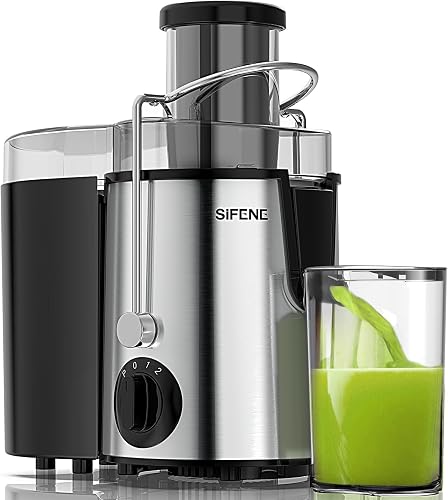
SIFENE Centrifugal Juicer Machine: Best for a separate pulp bin
- 3-inch feed chute
- 400 mL juice cup
- 1.5 L pulp container
- Two speeds and pulse
A separate 1.5 L pulp container and 400 mL juice cup give each ingredient its own space. The 3-inch chute fits many whole apples and smaller produce.
Pros
- Large pulp container
- Wide feed chute
- Includes cleaning brush
Cons
- Juice cup is sized for personal servings
- Assembly and rest guidance should be followed
SIFENE separates juice and pulp into a 400 mL cup and a 1.5 L container. That larger pulp bin can be handy when preparing several personal servings, since it gives pulp more room to collect.
The 3-inch chute fits many whole apples and smaller ingredients, and two speeds plus pulse offer options for different produce. Removable BPA-free food-contact parts are top-rack dishwasher safe, and a brush is included for the mesh filter.
Follow the assembly and rest guidance in the manual, along with the locking-arm instructions. The cup is still a personal-serving size, so pour into another container if you’re making a larger batch.
Choose SIFENE if a separate, roomy pulp bin matters for your routine.
How do you choose between citrus, centrifugal and cold press?
Choose the extraction type based on your usual ingredients. A dedicated citrus juicer is simplest for oranges and lemons, while centrifugal and cold-press machines handle a broader range of produce.
Centrifugal models use a spinning filter and are suited to fast batches. Their wide chutes can reduce prep, though you’ll still need to follow guidance for hard cores, low-juice ingredients and continuous run time.
Cold-press juicers use a slower pressing motion. TUUMIIST runs at 55 RPM, but its taller body and celery rest guidance may affect where and how you use it.
If most of your drinks start with citrus, compare the container and pulp controls on the two citrus models. For mixed produce, weigh chute width, speed settings and cleanup needs.
Does a wider feed chute save time?
A wider chute can reduce chopping for ingredients that fit through it, but it doesn’t mean every fruit can go in whole. The Juilist and GDOR models have 3-inch chutes, while TUUMIIST has a 5.8-inch chute.
The Magic Bullet Mini has a 2-inch chute, so larger pieces need more prep. Even with a wide opening, check the maker’s instructions for whole fruit, hard cores and produce that may clog a filter.
How much juice do you need to make at once?
Match the juice container to your typical batch. The BLACK+DECKER citrus pitcher holds 32 oz, Elite Gourmet holds 24 oz, and the Magic Bullet Mini’s cup holds 16 oz.
The GDOR includes a 17 oz jug, while SIFENE includes a 400 mL cup and a separate 1.5 L pulp bin. A large pulp container means fewer interruptions to empty pulp, but it doesn’t make the juice cup larger.
For family breakfast prep, prioritize a larger juice container or plan to pour servings into a pitcher. For one person, a cup that catches juice directly can simplify serving and cleanup.
What cleaning features matter for a budget juicer?
Look for removable parts, a brush for the filter and clear dishwasher guidance. Fine mesh filters can hold pulp, so a brush is useful even when some accessories are dishwasher safe.
Juilist and SIFENE include cleaning brushes, and the Magic Bullet Mini has top-rack dishwasher-safe attachments. Follow each model’s care instructions, especially around the motor base and parts that should be hand washed.
Are juicers under 100 dollars suitable for daily use?
They can suit regular home routines, but operating guidance varies by model. HOUSNAT describes its machine for light to moderate use, while QCen advises a maximum 5-minute run before a break.
TUUMIIST recommends a 20-minute pause after each 20 minutes of celery juicing. If you make large batches every day, check rest periods and batch capacity before choosing a smaller budget machine.
Verdict: which juicer under 100 dollars should you choose?
Choose the Juilist for mixed whole-produce prep, the BLACK+DECKER for measured citrus batches, or the TUUMIIST if you prefer slow pressing and have room for its taller body. For a personal cup, the Magic Bullet Mini keeps serving simple.
If your budget can stretch, compare the wider set of options in our best juicers under 200 dollars guide. Let your main ingredients and usual batch size decide which features are worth prioritizing.
Our top 3 picks at a glance
-
1
Best for measured citrus batches
BLACK+DECKER 32oz Electric Citrus Juicer
9.7/10 our score
See it on Amazon -
2
-
3
Frequently asked questions
Can a juicer under 100 dollars handle whole fruits?
Some centrifugal juicers in this group have a 3-inch feed chute that fits many whole apples and smaller produce. Larger or awkward ingredients may still need cutting.
Check the chute size and the maker's guidance for hard cores, leafy greens and high-fiber vegetables before choosing.
Is a centrifugal or cold-press juicer better under 100 dollars?
A centrifugal juicer suits faster batches and often has a wide feed chute, while a cold-press model extracts juice at a slower speed. The TUUMIIST runs at 55 RPM and has a 5.8-inch chute.
Choose by the produce you juice and how much time you want to spend preparing and cleaning.
Are citrus juicers useful if I want vegetable juice?
No, citrus presses are designed for oranges, lemons, limes and similar fruit. The BLACK+DECKER and Elite Gourmet models here focus on citrus.
For carrots, apples or leafy produce, choose a centrifugal or cold-press juicer instead.
What should I compare when choosing a juicer under 100 dollars?
Compare extraction type, feed-chute size, container capacity, speed controls and cleanup. A wide chute can cut prep time, while a larger pulp bin can reduce pauses during a batch.
For occasional citrus, a dedicated press may take less space and have fewer parts to clean.
How long can I run a budget juicer continuously?
Follow the instructions for the exact model. QCen advises limiting operation to 5 minutes at a time and allowing 15 minutes to cool after overheating.
TUUMIIST advises a 20-minute pause after each 20 minutes of juicing celery.
Other models may have different limits.