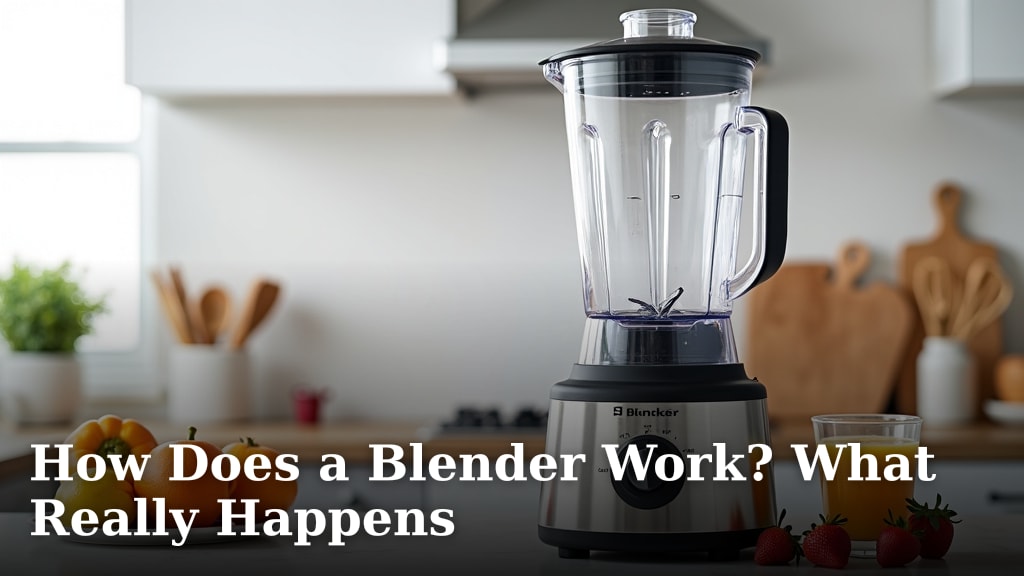
How Does a Blender Work? What Really Happens
A blender works by using a powerful motor to spin sharp, high-speed blades at the bottom of a jar. This violent spinning action crushes, mixes, and liquefies food and drinks in seconds.
The magic happens in the vortex created inside the jar. Your ingredients are pulled down toward the spinning blades, which chop and pulverize everything on contact. It’s a simple but very effective mechanical process.
- The core job is done by an electric motor in the base.
- This motor spins a coupling connected to the blade assembly at high speed.
- The blades create a powerful vortex that pulls food into them.
- Ingredients are rapidly chopped, mixed, and blended into a smooth texture.
- Speed settings let you control the power for different tasks like chopping or pureeing.
Let’s break down each part of this process, from the motor to the vortex, so you know exactly what’s happening in your kitchen.
Breaking Down the Blender’s Inner Workings
A blender is a common kitchen appliance, but what happens when you press “on”? You see food whirl into a smoothie in seconds, but the science inside is straightforward. We’ll look at the key parts that make it happen. The entire process relies on brute force and clever design.
Think of it like a miniature tornado trapped in a jar. Your job is to add the fruit. The blender’s job is to turn that tornado into your drink. Let’s see how each part plays its role.
The Heart of the Machine: The Electric Motor
Everything starts in the base of your blender. Housed inside is a powerful electric motor. When you plug it in and press a button, electricity spins this motor at incredible speeds. Most motors run between 300 and 1,500 watts. A standard household outlet is about 1,800 watts, so a blender uses a significant chunk of that power.
The motor’s job is simple: spin. But it spins a component called the coupling. This is a small gear or drive socket. It connects the motor inside the base to the blade assembly on the jar. It’s the critical link that transfers all that power upward.
Why a Powerful Motor Matters
A stronger motor can spin faster and handle tougher jobs. Crushing ice, blending frozen fruit, or making nut butter needs more force. A weak motor might struggle, overheat, or burn out. Research from consumer testing groups often finds that higher wattage correlates with better performance on hard ingredients. It’s about torque, or twisting force, not just raw speed.
The Business End: High-Speed Blades
Connected to the motor via the coupling is the blade assembly. These are the sharp, angled pieces of metal at the bottom of the jar. They are not perfectly straight. Most have four prongs, with some angled up and some down. This design isn’t random.
The upward-angled blades are designed to pull ingredients down. The downward-angled blades chop and push them back up. This creates a churning, chaotic motion. The blades are hardened stainless steel. They need to be durable enough to withstand hitting hard foods at high speed.
Blades Are Not Just for Chopping
While we call them “blades,” they do more than just cut. At high speeds, they act more like a blunt force instrument. They pulverize cells in fruits and vegetables. This releases water and breaks down fiber. That’s how you get a smooth liquid from solid pieces. It’s less about slicing and more about obliteration.
The Secret Ingredient: Creating the Vortex
This is where the real magic happens. When the blades spin rapidly, they push liquid and food away from the center. This creates a low-pressure zone in the middle. The result is a powerful vortex. It’s like the drain in your bathtub, but spinning at thousands of revolutions per minute.
This vortex is the engine of blending. It continuously pulls ingredients from the top and sides down into the blades. Without a vortex, the blades would just spin in a hole at the bottom. You’d have to stop and scrape the sides constantly. The vortex makes blending automatic and efficient.
How the Vortex Pulls Everything In
Imagine dropping a leaf into a whirlpool. It gets sucked right down to the center. Your banana chunks are that leaf. The spinning blades create the whirlpool inside the jar. This self-feeding action is why you can blend thick mixtures without constant stirring. The vortex is the unsung hero of your smoothie.
Control at Your Fingertips: Speed Settings
You don’t want everything blended at maximum power all the time. That’s why blenders have speed settings. From low to high, and often a “pulse” option. These settings control the motor’s speed. The slower you go, the less forceful the vortex and blade action.
Use a low speed for mixing or combining delicate ingredients. A medium speed is good for pureeing softer foods. High speed is for crushing ice and breaking down tough, fibrous materials. The pulse setting gives you short bursts of power. It’s perfect for chopping without over-processing.
Choosing the Right Speed for the Job
Starting on low is often best. It pulls ingredients down without splashing them up the sides. Then you can ramp up to high to finish the job. Using the correct speed gives you better texture. It also prevents your motor from straining unnecessarily. It’s like choosing between a gentle stir and a full-on whisk.
The Jar’s Role: More Than Just a Container
The jar design is crucial for the vortex to form properly. Its shape is usually wider at the top and narrower near the blades. This tapered design helps funnel ingredients downward. Many jars also have vertical ridges, called ribs or fluting, on the inside.
These ridges serve a purpose. They disrupt the smooth flow of liquid. This prevents ingredients from just spinning around the outside in a smooth circle. The turbulence forces more food down into the blades. A smooth jar would be far less efficient at blending thick mixtures.
Materials: Glass vs. Plastic
Jars are typically made from glass or durable plastic like Tritan. Glass is heavy and resistant to scratching and odors. Plastic is lighter and less likely to shatter. The material doesn’t change how it blends, but it affects durability and ease of cleaning. Both work well when designed with the proper shape.
Putting It All Together: A Blending Sequence
Let’s follow the journey of a simple strawberry smoothie. You add liquid, yogurt, and strawberries. You press “high.” The motor roars to life, spinning the blades at over 20,000 RPM.
The blades instantly attack the strawberries at the bottom. The vortex forms and pulls the rest of the fruit down. The entire contents are in violent motion. The solid fruit is pulverized, releasing its juice. Everything mixes together in a chaotic storm. Within 30-60 seconds, you have a uniform liquid.
Safety and Maintenance Keep It Working
These machines are powerful, so safety matters. The jar must be locked onto the base properly. Most have safety switches that prevent operation if not seated correctly. Never put your hand inside the jar while it’s plugged in. Use a tamper tool if your blender comes with one for thick mixtures.
Cleaning is straightforward. The best practice is to blend warm water with a drop of soap right after use. This cleans the blade area where food gets stuck. Never submerge the motor base in water. Regular care ensures your blender lasts for years of smoothies and soups.
Quick Checklist: What’s Happening in Your Blender
- Motor Spins: The electric motor in the base activates at high speed.
- Coupling Connects: Power transfers from the motor up to the blade assembly.
- Blades Rev: The sharp, angled blades spin to crush and pulverize food.
- Vortex Forms: A whirlpool-like funnel is created, pulling ingredients down.
- Ingredients Cycle: Food is constantly pulled into the blades from top to bottom.
- Speed Controls Force: You adjust the power to match the task, from chop to puree.
Conclusion
At its core, your blender is a clever assembly of simple parts working in violent harmony. A powerful motor spins sharp blades at incredible speed, creating a vortex that pulls everything into the action. This process pulverizes food at a cellular level, turning solids into smooth liquids. Understanding this helps you appreciate why a sturdy motor and a well-designed jar matter so much. For your next smoothie, start on a low speed to let the vortex form, then ramp up to finish. That simple habit gives you perfect texture every time.
Frequently Asked Questions
Can a blender really heat soup?
Yes, but not with a heating element. The friction from the blades spinning at high speed generates significant heat. This process, called friction heating, can bring a cold soup to a warm, steaming temperature after several minutes of continuous blending on high. It’s not a replacement for a stove, but it works for reheating or initial warming.
Why does my blender get stuck on thick mixtures?
Thick mixtures like nut butter or frozen acai can be too dense for the vortex to form properly. The blades spin in an air pocket at the bottom instead of pulling ingredients down. Using the tamper tool your blender came with (or stopping to scrape the sides) is the best solution. Adding a bit more liquid also helps the vortex engage.
What’s the difference between a blender and a food processor?
While both have blades, their designs serve different purposes. A blender’s tall jar and angled blades are optimized to create a vortex for liquids, making smoothies and purées. A food processor has a wider, shorter bowl with blades that chop and slice, ideal for tasks like making salsa, shredding cheese, or kneading dough.
Is it normal for my blender to be so loud?
Yes, most blenders are loud due to the powerful motor and blades crushing hard ingredients. The noise level often correlates with power. Research from consumer testing groups shows higher-wattage models, which handle tough jobs better, tend to be louder. Placing a folded towel under the base can help dampen vibration noise slightly.
How often should I replace the blade assembly?
You typically don’t need to replace blades unless they become visibly damaged, bent, or dull after years of use. Most are made from hardened stainless steel designed to last. If you notice your blender is no longer chopping efficiently or is leaving chunks, inspect the blades. For most users, it’s a part that lasts the lifetime of the machine with proper care.