9 Best Juicers for Beets and Carrots (November 2026)
The best juicers for beets and carrots include the QCen Juicer Machine 500W Centrifugal Juicer for two-speed root juicing, the Juilist Juicer Machines for three speed choices, and the Hamilton Beach Centrifugal Juicer Machine With Big for skipping some chopping.
On this page (4 sections)
The best juicer for beets and carrots is a machine designed for hard, dense vegetables, with a feed chute and batch size that fit your routine. If you are weighing whether to juice beets, compare beet powder and beet juice.
The Ninja NeverClog is a strong match because its maker names both beets and carrots among the ingredients it handles; choose a wide-chute cold press model for larger prep sessions.
Beets and carrots are firm roots, so a machine's ability to process hard produce matters more than an extra drink setting. Think about how much you juice at once, how much cutting you are willing to do, and how you want to clean the parts afterward.
If you are comparing machines for other dense vegetables too, see our guide to the best juicer for hard vegetables. Our separate guides to the best juicer for beets and the best juicer for carrots focus on each root individually.
Our picks at a glance
-
1
 Best for two-speed root juicing
QCen Juicer Machine 500W Centrifugal Juicer
9.7/10 our score
See it on Amazon -
2

-
3
 Best for skipping some chopping
Hamilton Beach Centrifugal Juicer Machine With Big
9.6/10 our score
See it on Amazon
- 4
 Best for large prep batchesCheck it
- 5
 Check it
TUUMIIST 3-in-1 Cold Press Juicer Machine
Best for whole-produce feeding - 6
 Best for a light kitchen finishCheck it
- 7
 Check it
Ninja NeverClog Cold Press Juicer
Best for dense roots and pulp choice - 8
 Best for foam separationCheck it
- 9
 Check it
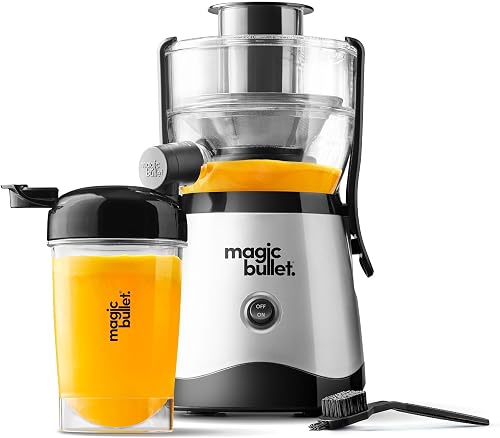
Magic Bullet Mini Juicer with Cup
Best for compact single servings
Which juicers work best for beets and carrots?
The best juicers for beets and carrots clearly support hard or fibrous produce, with a chute and capacity that match your prep. The picks below include centrifugal machines with hard-produce speed settings and cold press models made for dense ingredients.
We compared the stated features against the task of processing two root vegetables together. Our score weighs specs, features and buyer feedback against what you're shopping for, with extra weight on root handling, feed convenience and useful capacity.
| Product | Best for | Type | Power | Feed chute | Our score |
|---|---|---|---|---|---|
| QCen Juicer Machine 500W Centrifugal Juicer | two-speed root juicing | Centrifugal | 500W | 3 in | 9.7 |
| Juilist Juicer Machines | three speed choices | Centrifugal | Up to 800W | 3 in | 9.6 |
| Hamilton Beach Centrifugal Juicer Machine With Big | skipping some chopping | Centrifugal | 800W | 3 in | 9.6 |
| EanOruus Juicer Machines | large prep batches | Cold press | 6.5 in | 9.4 | |
| TUUMIIST 3-in-1 Cold Press Juicer Machine | whole-produce feeding | Cold press | 6.5 in | 9.3 | |
| EanOruus Juicer Machines | a light kitchen finish | Cold press | 6.5 in | 9.3 | |
| Ninja NeverClog Cold Press Juicer | dense roots and pulp choice | Cold press | 9.2 | ||
| GDOR 800W Juicer Machine | foam separation | Centrifugal | 800W | 3 in | 9.2 |
| Magic Bullet Mini Juicer with Cup | compact single servings | Centrifugal | 400W | 9.1 |
What should you check in a juicer for carrots and beets?
A juicer for carrots and beets should have a clear path for hard produce, a practical feed opening and instructions that suit your preferred prep. If leafy greens are also in your routine, compare juicers for leafy greens.
Check these details before you compare extra modes or finishes.
Does the juicer say it handles hard roots?
A high speed setting is useful when the maker identifies hard vegetables such as carrots as suitable. For beets, look for explicit root guidance or a machine described for hard, fibrous produce, and feed pieces gradually.
A dedicated root-vegetable guide can help narrow the options. Our best juicer for beets comparison looks specifically at beet handling and the features that matter for that root.
How wide should the chute be?
A wider chute can reduce cutting, but it does not mean every beet or carrot should go in whole. A 3 in opening fits larger produce pieces than a 2 in opening, while the 6.5 in models here are designed to accept large whole fruits and vegetables.
Measure the pieces you usually prep against the chute and follow the machine's feed instructions. For beets, trimming and cutting into manageable pieces can make feeding easier and help you avoid forcing produce.
Is a batch hopper useful for root blends?
A large hopper helps when you plan to load ingredients for multiple servings. For a single glass, a smaller jug may take less counter space and reduce the amount of machine you need to assemble and clean.
The EanOruus and TUUMIIST models have 100 oz capacity claims, while the Ninja includes a 24 oz juice jug. Choose capacity based on your usual batch, not on the largest number alone.
What matters for cleanup?
Cleanup depends on removable parts and their care instructions. Some picks include dishwasher-safe parts or accessories, while the QCen and EanOruus models specify hand washing.
Root pulp can collect around strainers and outlets, so check how the juicer comes apart and whether a brush is included. A machine you can clean after each session is more practical for regular use.
How do the nine juicers compare?
The QCen and Juilist lead this list by score, while cold press options offer different chute sizes and root-handling details. Use the table to match speed, feed opening and capacity to the way you plan to juice.
QCen Juicer Machine 500W Centrifugal Juicer: Best for two-speed root juicing
- 500W motor
- Two speeds
- 3 in feed chute
- High speed for carrots
Two speed settings include a high setting for hard produce such as carrots. The wide chute can reduce prep for larger pieces.
Pros
- High speed for hard produce
- Wide feed chute
- Detachable parts
Cons
- Avoid produce with low water content
- Hand wash only
The QCen is a useful fit if you want a straightforward centrifugal machine with a speed for hard produce. Its two settings include a high speed for carrots, and the 3 in feed chute may reduce cutting for pieces that fit.
Beets are not named in the provided feature details, so use manageable pieces and follow the machine's guidance. QCen advises avoiding ingredients with low water content, a point to consider if your blend includes dry or fibrous produce.
The detachable parts are described as easy to clean, but the care instruction is hand wash only. This suits buyers who prefer a basic setup and do not need a dishwasher-safe cleanup routine.
Choose this model for two-speed control and a wide chute in a centrifugal juicer. It is less suited to buyers who want cold press extraction or a machine with explicit beet guidance.
Juilist Juicer Machines: Best for three speed choices
- Up to 800W
- Three speed functions
- 3 in feed chute
- Brush included
Its high setting is intended for hard foods such as carrots, and the 3 in chute helps reduce cutting. Use small amounts of high-fiber vegetables that are low in juice.
Pros
- High speed for hard foods
- Three speed functions
- Dishwasher-safe accessories
Cons
- High-fiber, low-juice vegetables should be juiced in small amounts
- Hard fruits are not recommended
The Juilist gives you three speed functions, including a high setting for hard foods such as carrots. Its 3 in chute can save some prep time, and the included brush helps clean the filter.
The manufacturer advises juicing high-fiber vegetables that are low in juice in small amounts, and it does not recommend hard fruits. That guidance makes gradual feeding especially relevant when combining dense roots.
Its accessories are dishwasher safe, which can simplify cleanup after a root blend. The compact design may also appeal if counter space is limited.
Choose it if you want several speed choices and a wide opening in a centrifugal machine. Keep the maker's guidance in mind and do not treat the highest setting as permission to overload the feed chute.
Hamilton Beach Centrifugal Juicer Machine With Big: Best for skipping some chopping
- 800W motor
- 3 in feed chute
- 80 oz pulp bin
- Dishwasher-safe removable parts
The wide chute fits a handful of carrots, while the 80 oz pulp bin supports larger juicing sessions. Its single speed keeps operation simple.
Pros
- Wide chute fits a handful of carrots
- Large pulp bin
- Several removable parts are dishwasher safe
Cons
- One speed
- The chute does not mean every beet will fit whole
The Hamilton Beach has an 800W motor and a 3 in chute that fits a handful of carrots. An 80 oz pulp bin can also be useful when you are juicing several servings before emptying the bin.
This model has one speed, so there is no separate setting to select for soft versus hard produce. The stated use covers hard and soft foods, but cut roots to fit and feed them without forcing.
Removable parts, including the pulp bin, juice bowl, lid and pusher, are dishwasher safe. That cleanup detail may matter if beet juice is part of your regular routine.
Choose it for a large pulp bin and a wide chute with simple single-speed operation. If you want more control over speed or pulp texture, compare the other picks.
EanOruus Juicer Machines: Best for large prep batches
- Cold press
- 6.5 in feed chute
- 100 oz hopper
- Juice and sorbet strainers
The extra-wide chute and large hopper suit batch prep. Its cold press design is described as handling hard, fibrous ingredients.
Pros
- Very wide feed chute
- Large hopper
- Interchangeable juice and sorbet strainers
Cons
- Hand wash only
- Large capacity may be more than a single glass needs
The gray EanOruus cold press model suits larger batches, with a 6.5 in feed chute and 100 oz hopper. Its maker describes the AC motor as able to crush hard, fibrous ingredients, which fits the dense-root task.
It comes with juice and sorbet strainers, and the product description also names nut milk as a use. Those extra functions are useful only if you plan to make those foods; the main reason to consider it here is the large feed opening and hopper.
The parts are hand wash only, so allow time for cleanup after juicing. Its larger capacity may be more machine than you need for an occasional single glass.
Choose it for batch prep and a very wide chute. Consider a smaller juicer if your counter space or usual serving size is limited.
TUUMIIST 3-in-1 Cold Press Juicer Machine: Best for whole-produce feeding
- Cold press
- 6.5 in chute
- 100 oz capacity
- Juice, nut milk and sorbet modes
Its wide self-feeding chute and large capacity suit a batch that combines root vegetables with other produce. The recommended uses include beetroot and carrot.
Pros
- Beetroot and carrot are recommended uses
- Wide chute
- Multiple functions
Cons
- Large capacity takes more counter space
- The maker's yield figure is a claim, not a guarantee
The TUUMIIST is a strong fit for root blends because its recommended uses include beetroot and carrot. The 6.5 in self-feeding chute and 100 oz capacity also suit preparing several servings at once.
It is a cold press model with juice, nut milk and sorbet functions. The maker claims up to 95% juice yield, but actual results depend on the produce and how you use the machine.
The machine has a simplified three-part assembly and quick-release design. Those details may help keep cleanup manageable after a larger batch, though the listed capacity still calls for enough storage and counter space.
Choose it when explicit beetroot and carrot guidance is your priority. If you usually make only one small serving, a compact model with a smaller jug may fit better.
EanOruus Juicer Machines: Best for a light kitchen finish
- Cold press
- 6.5 in feed chute
- 100 oz hopper
- Bright white finish
This version has the same stated chute and hopper size as the gray EanOruus model, with a bright white finish. Its maker describes it as suitable for hard, fibrous ingredients.
Pros
- Wide feed chute
- Large hopper
- Interchangeable juice and sorbet strainers
Cons
- Hand wash only
- No specific beet or carrot use is named
The white EanOruus offers the same stated 6.5 in chute and 100 oz hopper as the gray model. Its maker describes it for hard, fibrous ingredients, while the white finish gives you a different look for the counter.
The two interchangeable strainers support juice and sorbet, and the machine is also described for nut milk. No specific beet or carrot recommendation is named, so compare it with the TUUMIIST if you want explicit guidance for both roots.
The parts are hand wash only. That is a meaningful tradeoff for a large-batch juicer, where more produce and a larger hopper can mean more cleanup.
Choose this version if you want its capacity and chute size with a bright white finish. Pick a smaller setup if you want less to wash after a single drink.
Ninja NeverClog Cold Press Juicer: Best for dense roots and pulp choice
- 150W high-torque motor
- Cold press auger
- Two pulp filters
- Reverse program
Ninja names beets and carrots among the dense ingredients this juicer handles. Two pulp filters let you choose a smoother or more textured drink.
Pros
- Beets and carrots are named as suitable ingredients
- Two pulp options
- Dishwasher-safe juice-contact parts
Cons
- Smaller jug than the batch models
- Feed chute size is not specified here
The Ninja NeverClog is the clearest match for dense roots because its maker names both beets and carrots among the ingredients it handles. Its 150W high-torque auger uses a cold press approach, and the reverse program can help reduce jams.
Two interchangeable filters let you choose less pulp or more pulp. The included 24 oz juice jug and 36 oz pulp container suit modest batches without the 100 oz hopper found on larger models.
The juice-contact parts are dishwasher safe, which may make regular cleanup easier. The feed chute size is not specified here, so check the machine's instructions and cut roots to fit.
Choose the Ninja when root guidance and pulp choice matter more than a very wide chute. It is a practical pick for everyday servings rather than loading a large batch at once.
GDOR 800W Juicer Machine: Best for foam separation
- 800W motor
- Two speeds
- 3 in feed chute
- Foam separator in juice jug
The high speed is intended for harder produce such as carrots, and the jug has a built-in foam separator. Its maker recommends cutting prep with the wide chute.
Pros
- High speed for carrots
- Wide feed chute
- Foam separator
Cons
- Centrifugal design
- No specific beet guidance
The GDOR combines an 800W motor with a high speed setting for hard produce such as carrots. Its 3 in chute can reduce some cutting, and the juice jug includes a foam separator.
The machine is centrifugal, so it suits buyers who prefer a fast juicing style. Beets are not specifically named in the stated guidance, so cut them to fit and add them gradually.
A cleaning brush is included, and the safety features include a locking arm and automatic shutoff for overload or overheating. Consider those practical details alongside the two-speed controls.
Choose GDOR if you want a wide-chute centrifugal juicer with foam separation. For more direct beet guidance, compare the Ninja or TUUMIIST.
Magic Bullet Mini Juicer with Cup: Best for compact single servings
- 400W motor
- 2 in feed chute
- 16 oz cup
- Compact size
Its compact footprint and included 16 oz cup suit a small serving. The narrower chute means you may need to cut dense roots into smaller pieces.
Pros
- Compact size
- Juice directly into included cup
- Dishwasher-safe attachments
Cons
- Narrower chute than the other picks
- No specific beet or carrot guidance
The Magic Bullet Mini suits a small kitchen or a single serving, with a compact body and an included 16 oz cup. Its 2 in chute is narrower than the other picks, so dense beets and carrots will need more trimming.
The 400W motor extracts juice from fruits and vegetables, but no specific hard-root guidance is named. Cut the roots into pieces that fit and follow the user manual before operating the machine.
Top-rack dishwasher-safe attachments and a silicone spout cap support tidier cleanup. The compact size is its clearest advantage when you do not want a large juicer on the counter.
Choose it for a small footprint and direct-to-cup juicing. For frequent beet and carrot batches, a machine with a wider chute and explicit root guidance is a better fit.
Which juicer should you pick for a beet and carrot blend?
Pick a juicer based on how clearly it handles roots, how much you prepare, and how you prefer to clean it. For explicit beet and carrot guidance, the Ninja and TUUMIIST stand out; for a larger batch, compare the wide-chute EanOruus options.
If speed matters, the QCen, Juilist, Hamilton Beach and GDOR offer centrifugal designs with features for hard produce or larger feed openings. If you want more context for carrot prep, read our guide to the best juicer for carrots.
For a one-glass routine, the Ninja or Magic Bullet may be easier to size around than a large hopper. For repeated batches, consider capacity and cleanup before choosing the biggest chute.
The best juicer for carrots and beets is the one that fits your produce and routine. Choose a model with clear hard-root guidance, feed pieces steadily, and use our how to juice beets guide for practical prep steps.
Our top 3 picks at a glance
-
1
Best for two-speed root juicing
QCen Juicer Machine 500W Centrifugal Juicer
9.7/10 our score
See it on Amazon -
2
-
3
Best for skipping some chopping
Hamilton Beach Centrifugal Juicer Machine With Big
9.6/10 our score
See it on Amazon
Frequently asked questions
Can one juicer handle beets and carrots together?
Yes. Choose a model described for dense or hard vegetables, then feed beet and carrot pieces gradually.
A cold press model can suit fibrous roots, while a centrifugal juicer with a high speed setting can suit faster prep.
Cut produce to fit the chute and follow the juicer's instructions.
Should beets and carrots be cut before juicing?
Cut them to fit the feed chute, even when it is wide. Whole roots can be awkward to feed, and smaller pieces let you add them steadily.
Wash and trim the produce first, then check the machine's instructions for acceptable sizes and preparation.
Is a cold press or centrifugal juicer better for carrots and beets?
Either type can work when the model is designed for hard produce. Cold press models use an auger and may be a good fit for fibrous roots, while centrifugal models often offer a high speed setting for hard vegetables.
Compare chute size, cleanup and batch capacity.
How should I choose a juicer for carrot and beetroot?
Look for clear guidance on hard or fibrous produce, a chute that fits your usual prep pieces, and a capacity that matches your batch size. For beetroot specifically, the best juicers for beets page compares more options.
Feed roots gradually and avoid forcing them.
Can I juice beets every day?
That depends on your diet and health needs. This guide covers equipment, not personalized nutrition advice, so ask a qualified health professional if you have a condition or concern about adding beet juice to your routine.
For prep steps, see how to juice beets.


